Voice AI has come a long way. Just a few years ago, “talking to a machine” meant wrestling with clunky IVR menus or robotic assistants. Today, conversational voice agents can reason, respond, and even interpret tone and emotion—all in real time.
But as voice AI technology matures, a familiar challenge appears for its builders: how do you scale performance and quality while controlling costs? The answer usually isn’t in adding more layers of technology—but in simplifying the architecture from the ground up.
Finding freedom beyond managed systems
In the early stages of development, many teams prototype quickly using managed systems like Vapi or LiveKit. These platforms make it easy to stand up a demo or MVP without worrying about telephony details.
However, as usage and complexity grow, the convenience comes with constraints.
Anecdotally, developers have noted that costs can hit $0.50 per minute on some closed systems—a rate that’s hard to sustain once call volumes multiply. And that adds up fast when you’re scaling. At that rate, 100k minutes costs $50k!
Beyond cost, these frameworks can also create performance bottlenecks. Plus, interruptions are more common when there are millisecond delays that disrupt the natural flow of conversational AI.
This is often the turning point for scaling teams. They begin removing intermediaries from the call flow and developing directly against a Voice API, where they can manage the media layer themselves. That’s where programmable infrastructure becomes a competitive advantage.
Your AI is ready. Is your network?
Stop fighting latency and inflated costs. We’ll back your AI genius with our bulletproof carrier foundation so you can be the next big thing.
Leveraging media streaming for scalable voice AI
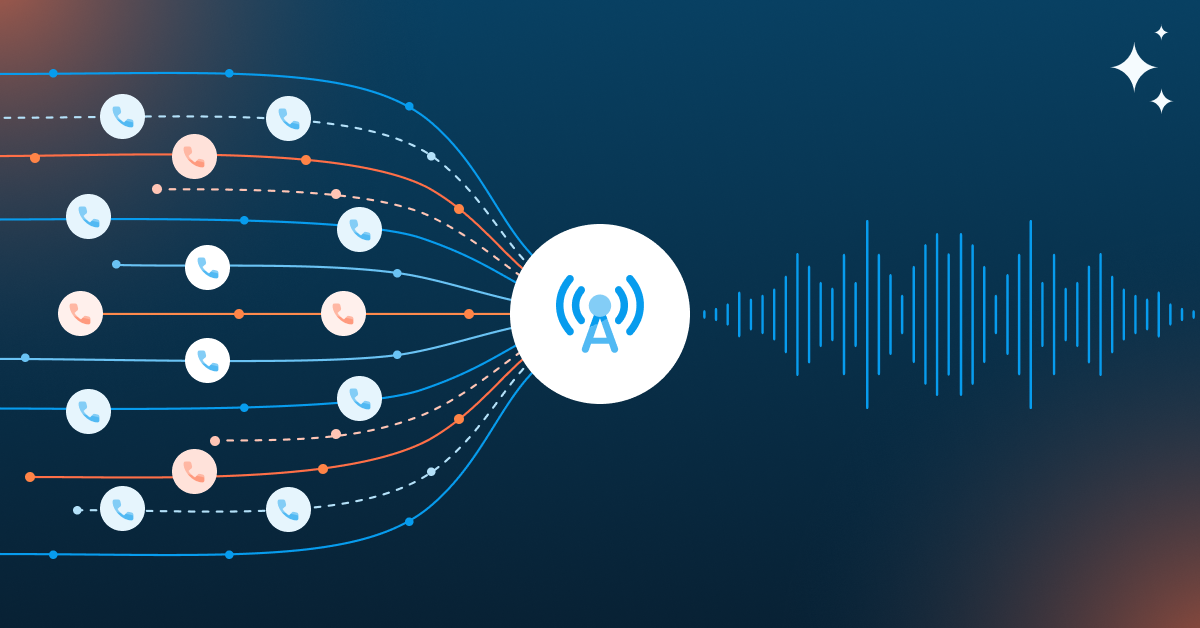
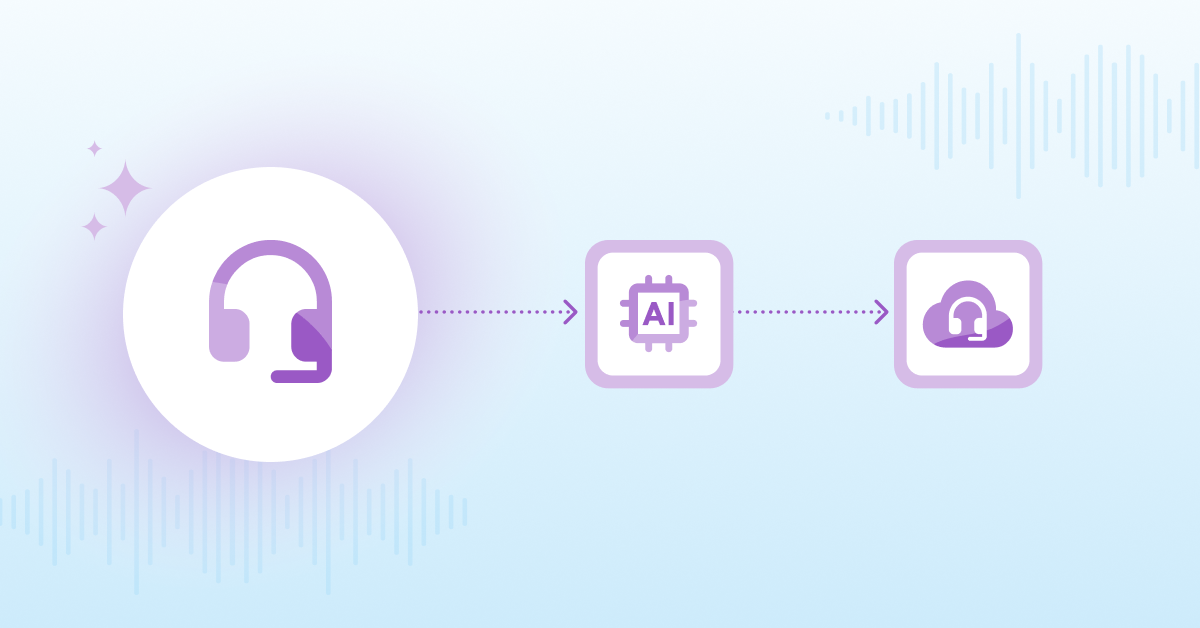
Media Streaming—the ability to send and receive real-time audio between your telephony layer and your AI models—is quickly becoming the backbone of scalable voice applications.
By streaming live audio directly, you can build an ultra-responsive loop between your callers and your AI engine. The result: dramatically lower latency, higher customization, and the freedom to integrate best-of-breed AI components.
Using a programmable, carrier-grade Voice API like Bandwidth’s, developers can minimize hops in their call flow, reducing the delay between spoken input and AI response to fractions of a second. That “instant” feeling is more than convenience—it’s what makes the conversation feel human.
Programmable Voice lets your team iterate faster, choosing the tools and models that fit your use case, instead of being confined to a single, managed stack.
The freedom to innovate means you can evolve your voice logic, experiment with different ASR (Automatic Speech Recognition) models, or integrate custom LLMs—all without rearchitecting your system.
Designing for ultra-low latency
When every millisecond counts, latency isn’t just a measure of performance—it’s a measure of experience.
Each “hop” in a Voice AI call flow adds delay. One service hands media off to another, which forwards it to yet another. Every intermediary introduces tiny—but cumulative—delays that users perceive as awkward pauses or talk-over moments.
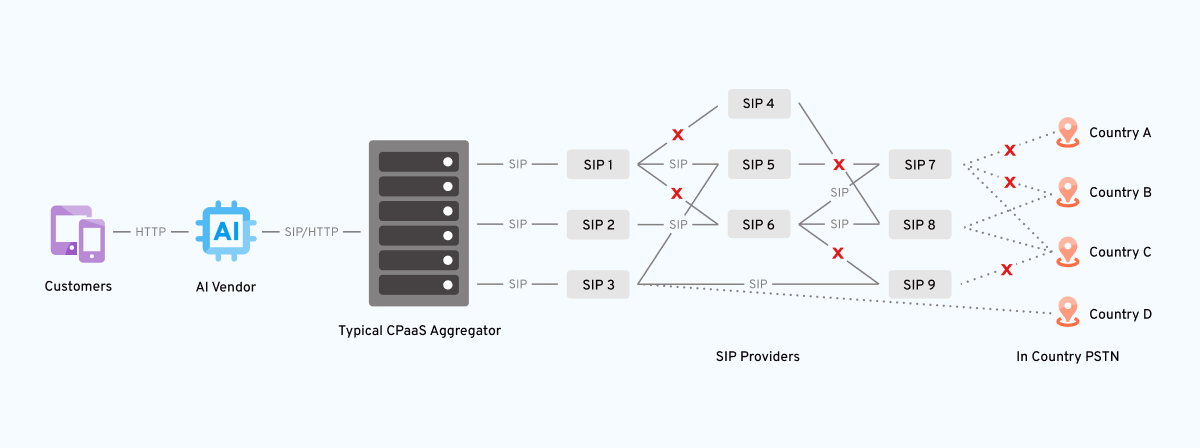
By designing your architecture around direct media streaming, you eliminate unnecessary hops and ensure a clean, efficient path between the user and your AI system. This effect is compounded when you work with a voice provider that has minimal hops in their network. This is how successful teams bake ultra-low latency into their foundation instead of patching it in later.
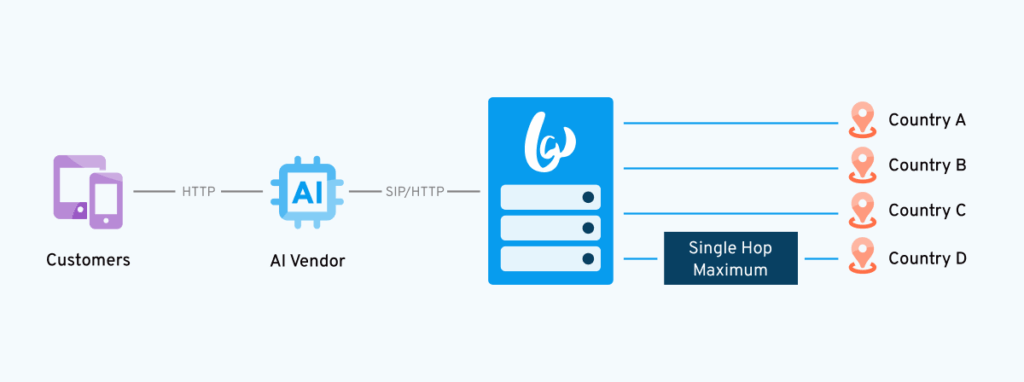
And it pays dividends. Human conversation naturally pauses about 200–300 milliseconds between speaker turns. Shave even half that from your call latency, and you’re creating something users subconsciously recognize as “real” conversation.
Working with a partner, not just a vendor
As your voice AI system matures, you’ll find yourself operating closer to the telecom layer—handling number provisioning, call routing, and the corresponding industry regulations for fraud, and global compliance.
That’s a lot to take on while still trying to enhance your AI pipelines.
This is why the distinction between a vendor and a partner matters.
A vendor sells you minutes.
A partner helps you scale your platform.
Choosing a partner like Bandwidth means your team is backed by direct-to-carrier network control, uptime reliability, and enterprise-grade security—without sacrificing API-level agility. While your engineers focus on speech recognition or large language model performance, your partner handles the telecom foundation and gives you the expert guidance that keeps you running smoothly.
This kind of partnership doesn’t just simplify operations—it actually accelerates innovation. When you know your voice infrastructure is secure, compliance-ready, and globally scalable, you’re free to devote 100% of your energy to enhancing your conversational experiences.
The Future of Voice AI: Open, Fast, and Human
Wharton Professor Ethan Mollick’s work on AI adoption is a reminder that technological leaps don’t happen in isolation—they change how we work, build, and interact. As Mollick recently wrote, “Even small increases in accuracy (and new models are much less prone to errors) leads to huge increases in the number of tasks an AI can do. And the biggest and latest ‘thinking’ models are actually self-correcting, so they don’t get stopped by errors. All of this means that AI agents can accomplish far more steps than they could before and can use tools (which basically include anything your computer can do) without substantial human intervention.”
Voice is central in the race to the top.
Tomorrow’s Voice AI systems won’t just answer calls—they’ll reason, contextualize, and act naturally across devices and channels. To reach that future, today’s developers need agility: control over data, the ability to optimize latency, and the freedom to choose the best tools for the job.
Starting with open media streaming, direct voice APIs, and trusted telecom partnerships sets you up for that kind of growth. As your usage scales and your AI gets smarter, your infrastructure will be ready to keep pace—without forcing painful migrations or cost spikes.
Be the next big thing in Voice AI—with Bandwidth
“For Voice AI agents, our advantage is clear. We own the network. And because we own the network, we can innovate at the physical edge. And we think that this is the key to unlocking the true potential of voice AI.”
Jason Sommerset, Principal, Product Strategy & Innovation, Bandwidth
Watch more of Jason’s talk at Reverb®
If you’re ready to move beyond closed frameworks and start architecting your voice AI for scale, discover Bandwidth’s Voice API. With real-time media streaming, global carrier connectivity, and an open framework designed for developers, you’ll have the tools and flexibility to build the next generation of Voice AI experiences: fast, reliable, and ready for growth.
Start calling today
Get your free Bandwidth Build credits and discover how our programmable Voice API and SIP Trunking set up AI hyperscalers for success.