Retail has shifted from aisles to conversations. And those conversations are now happening at a scale that no human agent team could sustain alone.
Conversational AI in retail is the technology making that scale possible. It layers natural language processing (NLP), machine learning, and large language models (LLMs) to understand what a customer is actually asking, not just what they typed or said, and respond in a way that moves the interaction forward. Integrated into existing contact center workflows, it doesn’t replace the experience. It accelerates it.
What today’s conversational AI can do would’ve been a pilot program wishlist five years ago. It handles multi-turn dialogue, recommends the right product based on context, processes a return over the phone without routing to a human agent, and can take a shopper from “I need a gift for my sister” to checkout in under two minutes. Provided, of course, it’s built on a high-fidelity, low-latency Voice foundation. Without that infrastructure layer, even the smartest AI sounds like it’s calling from a bad connection.
Here’s what makes this moment different from the last wave of retail automation hype: the results are in. A study found that 61% of customers now prefer an instant response from an AI agent over waiting for a human representative, even for complex queries[1]. This isn’t experimentation anymore. It’s measurable ROI.
What conversational AI in retail looks like in action
The best way to understand what’s happening is to look at who’s doing it and what it’s actually producing.
Amazon Rufus: The AI shopping assistant with a $12 billion impact
Amazon’s AI shopping assistant, Rufus, might be the clearest proof that conversational AI in retail has arrived.
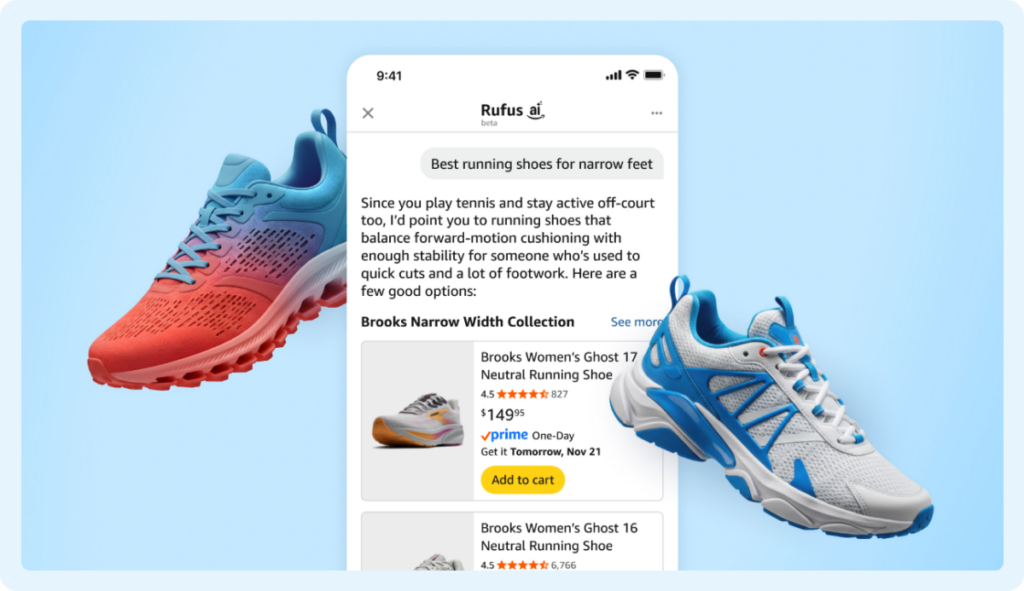
Launched in early 2024, Rufus is embedded directly into Amazon’s app and website. Shoppers can ask natural language questions, like: “What should I look for in noise-canceling headphones?” or “Is this jacket warm enough for winter?” and get useful, context-aware answers drawn from product catalogs, customer reviews, and web data.
The numbers tell the story. More than 300 million customers used Rufus throughout 2025. Shoppers who engaged with the assistant were over 60% more likely to complete a purchase. And by the end of the year, Amazon reported that Rufus generated nearly $12 billion in incremental annualized sales[2].
Rufus clearly demonstrates that seamlessly embedding LLMs into the customer journey creates measurable revenue. However, the real proof for infrastructure teams is the underlying orchestration required to maintain this level of high-concurrency interaction across millions of global users without service degradation or latency-driven cart abandonment.
Target: Turning chat into checkout
Target took a different approach. Instead of building its own standalone assistant, the retailer partnered with OpenAI to launch a full shopping experience inside ChatGPT. It likely required a robust API framework to link their inventory and fulfillment engines to a third-party LLM.

Shoppers can tag Target in the chat, ask for help planning a family movie night, and get curated product suggestions they can add to a cart and purchase in a single transaction. The experience supports grocery, multiple fulfillment options, and multi-item baskets. It all requires real-time synchronization between the AI’s output and Target’s backend ERP to ensure item availability and accurate delivery windows.
Target also noticed a telling shift in how people search on its own platform. Prat Vemana, Target’s chief information and product officer, told CNBC that about 25% of customer searches are now conversational in phrasing, not keyword-based. People aren’t typing “throw blanket grey”; they’re asking, “What’s a good cozy gift under $30?”
That behavioral change is reshaping how Target structures product data and descriptions across its entire digital experience. For infrastructure and data teams, this means moving away from static database queries toward a dynamic, low-latency data architecture that can feed high-token conversational requests without compromising site performance or search speed.
Smaller brands are adapting, too
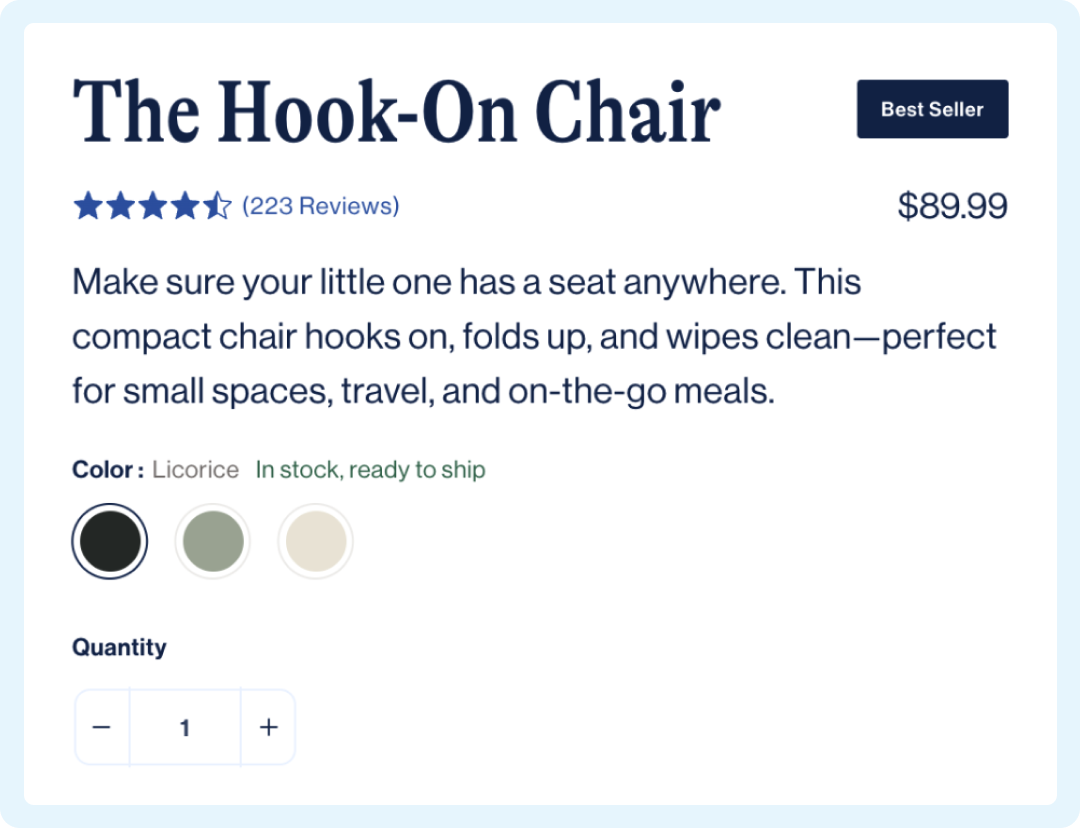
It’s not just the giants. Baby goods retailer Lalo restructured its product listings to answer the kinds of questions shoppers are now asking AI assistants. Instead of keyword-heavy specs, Lalo’s listings include phrases like “good for small spaces” and “best gifts for kids under one year old,” the exact language a parent might use when chatting with an AI shopping assistant.
Voice AI: The channel retail can’t ignore
While text-based chat gets the headlines, voice remains the critical channel for high-stakes retail moments like returns, order discrepancies, and high-consideration purchases. This is where AI-powered voice agents are replacing legacy, DTMF-based IVRs (“Press 1 for Sales”) with natural, real-time interactions.
Modern voice AI can handle calls in real time, understand what a customer needs, pull up order details, process a return, or route to a human agent with full context, all without the caller pressing a single button. For retailers running large contact centers, For retailers, this represents a massive shift in Average Handle Time (AHT) and a significant reduction in agent burnout.
However, the “intelligence” of the AI is irrelevant if the telephony layer is unstable. A voice AI experience is only as good as the carrier backbone underneath it. Latency (jitter), packet loss, and compliance all depend on the network layer. If the call quality is degraded, the AI’s speech-to-text engine will fail, breaking the customer experience before it even begins. In short, bad call quality breaks great AI in the call center.
Bandwidth provides the enterprise-grade programmable voice APIs and SIP trunking required to power these real-time interactions using any AI platform (Here’s how to Bring Your Own AI). Because Bandwidth is the owner of the network, we eliminate the “middleman” latency that plagues typical CPaaS providers. When a retailer deploys a conversational AI agent, Bandwidth acts as the communications backbone, ensuring the voice channel is clear, compliant, and ready for high-concurrency traffic.
The benefits of conversational AI in retail
Conversational AI in retail isn’t just exciting new technology. It solves real operational problems.
- It sells more. Amazon’s data makes this hard to argue with. Shoppers who interact with AI assistants convert at significantly higher rates. Target’s early data shows bigger cart sizes from its AI-powered Gift Finder. When customers can describe what they want in natural language and get relevant answers, they buy more, faster. You aren’t just solving a need, you’re solving a problem.
- It scales support without scaling headcount. AI-powered voice and chat agents can handle thousands of simultaneous conversations. That means retailers don’t need to staff up 3x for holiday surges or keep customers on hold for 20 minutes during peak volume. Routine inquiries get resolved instantly, and human agents focus on the interactions that actually require a human.
- It reduces friction. Returns, order tracking, product questions, and store hours are high-volume, low-complexity requests that eat up contact center resources. Conversational AI handles them in seconds across chat, SMS, and voice. Customers get answers without waiting. Agents get their time back.
- It makes personalization real. Not the “Dear [FIRST_NAME]” kind. Conversational AI can factor in past purchases, browsing behavior, and stated preferences to deliver genuinely useful recommendations. Amazon’s Rufus is a prime example.
The bottom line: Conversational AI helps retailers sell more, spend less, and deliver the kind of experience that keeps customers coming back.
The infrastructure question nobody’s asking (yet)
Here’s the thing about conversational AI in retail that most coverage misses: all of these experiences—voice agents, AI-powered phone support, real-time chat—depend on a reliable communications infrastructure that can bridge the gap between your carrier and your AI engine without adding latency.
When a customer calls a retailer and talks to an AI agent, that interaction needs to be fast, clear, and reliable. It needs to work during Black Friday traffic spikes just as well as it does on a quiet Tuesday without hitting CPS (calls per second) throttles. It needs to comply with regulations around call recording, data handling, and consumer privacy while maintaining high availability across global sites.
Bandwidth provides the communications platform, including programmable voice and messaging APIs built on a tier-1 global network, that power these kinds of experiences.
As conversational AI moves from experiment to essential infrastructure, the communications layer will only become more important. The retailers building on unified, API-forward foundations today are the ones who’ll scale confidently tomorrow without the headache of vendor sprawl or integration friction.
What’s next: Where conversational AI in retail is going
The next phase of conversational AI in retail isn’t about answering questions. It’s about taking action. Amazon’s “Buy for Me” feature already lets Rufus shop across other online stores and make purchases on a customer’s behalf. That’s a different model where AI isn’t just assisting the shopping journey, but executing it.
Voice will play a central role in that shift. As voice AI improves at handling complex, nuanced conversations, more retailers will deploy it as a frontline engagement tool, not just a support deflection strategy. The ones investing in reliable, low-latency voice infrastructure now will have an edge as this channel grows.
Meanwhile, the way retailers describe their products is about to change. Target and Lalo are early examples of a much bigger movement: as AI tools become the front door for shopping, product data will need to be reworked around the questions customers actually ask, not just keyword-optimized specs.
Think rich, contextual descriptions that work in a conversation, not just a search result. It’s the retail equivalent of the answer engine optimization shift happening across the broader digital landscape.
Conversational AI in retail is moving fast
Want to understand how voice infrastructure fits into the picture?

[1] Intercom, Customer Service Trends Report 2024
[2] Modern Retail, Amazon says its AI shopping assistant is gaining traction, with Rufus users up 115%