Financial services are built on trust. And in this industry, trust is tested the moment a customer calls about a suspicious charge or a complex loan.
While the need for that connection hasn’t changed, the infrastructure behind it has.
Conversational AI is no longer just a chatbot in intelligent call center systems; it’s now AI-powered voice agents capable of verifying identity and handling complex interactions integrated directly into the call flow. When done right, today’s AI can verify identity, handle routine transactions, and crucially, hand off to a human agent with full context.McKinsey estimates that generative AI could add $200–340 billion in annual value for the finance sector alone[1]. The challenge isn’t the AI itself; it’s the integration. To scale, financial institutions need a foundation that ensures high-fidelity audio for voice bots, global PSTN reach, and full interoperability across a hybrid mix of legacy on-prem and cloud CCaaS platforms.
Conversational AI vs Chatbots
Conversational AI is not the same thing as a chatbot. Traditional chatbots are more rigid in their decision-making and use pre-written responses that work well for simple FAQs, but fall apart when a customer asks something outside of their programmed responses.
Conversational AI, on the other hand, understands context and maintains state across the interaction. It can pull up account details, walk someone through a loan application, flag a suspicious charge, or hand off to a human specialist, all within the same conversation. Most importantly, it can initiate a warm hand-off to a human specialist. It can transfer the SIP signaling and customer context so that the caller never has to repeat themselves.
How financial institutions are using Conversational AI
Conversational AI in finance isn’t theoretical. Some of the world’s largest financial institutions are running it at scale across complex, global voice networks.
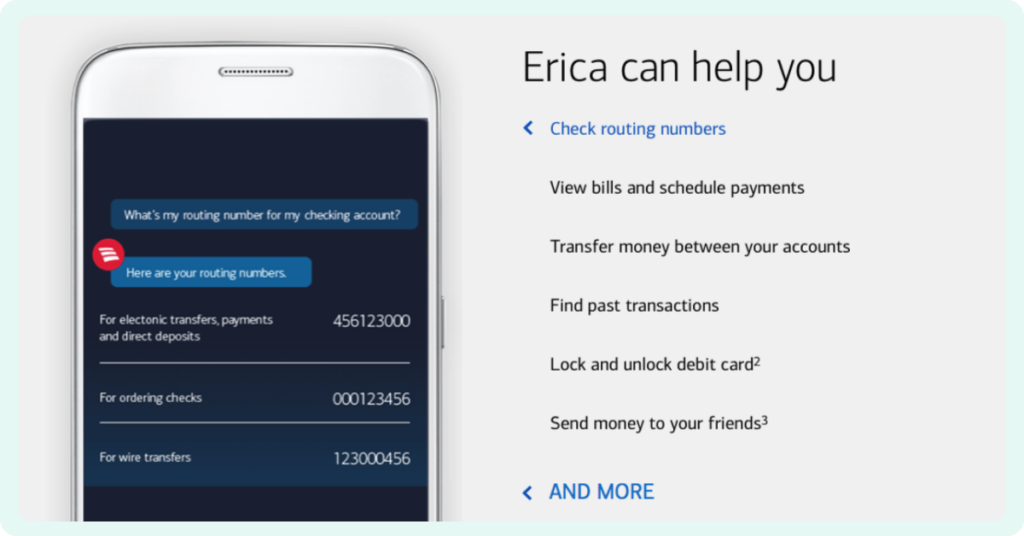
Bank of America’s Erica is the most widely adopted AI-powered virtual assistant in the industry. For an infrastructure team, the scale is the story: managing over 58 million interactions per month requires a carrier-grade foundation that can handle massive concurrent call spikes without latency. By resolving 98% of queries within the AI layer, systems like Erica help reduce load on live agent pools and, critically, on the underlying voice infrastructure.

Commonwealth Bank of Australia has moved beyond simple FAQs, building an assistant capable of handling 200+ banking tasks. From an engineering perspective, this requires the AI to be deeply integrated via secure APIs into core banking systems, processing transfers and bill pays with an architecture designed to support PCI and SOC 2 audit requirements across voice sessions.
The winners in this space aren’t just picking the best “brain” (LLM); they are picking the best connectivity partner to ensure that when a customer moves from an app-based chat to a high-priority voice call, the transition is low-latency and the audio is crystal clear for the NLP engine.

The benefits of conversational AI in finance
Conversational AI solves problems that financial institutions have been throwing headcount at for decades. Here’s where the impact shows up first.
24/7 reliability without the ‘hold’ music. Conversational AI provides an immediate response layer for high-stakes calls, like 2 a.m. fraud alerts. For your team, this means reducing the load on your contact center and global SIP trunks during off-hours while maintaining a consistent grade of service that isn’t dependent on BPO shift changes.
Scales without the staffing headache. During market volatility or tax season, call volumes don’t just grow; they spike. Conversational AI acts as a buffer at the network edge, absorbing these surges so your CCaaS platform doesn’t hit concurrent call limits and your agents don’t get buried.
Data-driven personalization. 72% of customers say personalization influences where they bank[2]. Conversational AI delivers that at scale by analyzing spending patterns and tailoring advice based on a customer’s actual financial behavior.
Built-in auditability. In a heavily regulated environment, logging isn’t enough. When every interaction is natively transcribed and encrypted at the transport layer, your team gets a proactive, structured data stream, not a manual audit backlog. That kind of always-on visibility gives compliance teams the raw material they need, without bolting it on after the fact.
Where voice ties into conversational AI in finance
Most coverage of conversational AI in finance focuses on chat. That makes sense, as text-based interactions are easier to deploy and iterate on. But voice remains the channel customers reach for when the stakes are high. Reporting fraud, disputing a charge, asking about a mortgage, navigating a complex claims process—these aren’t moments where people want to type into a widget and wait. They want to talk.
AI-powered voice agents can now handle these calls in real-time, but a voice AI experience is a function of the telephony infrastructure underneath it. In finance, there is zero tolerance for jitter, packet loss, or disruptions. If the network layer fails, the AI fails.
This is where Bandwidth operates, providing the programmable voice APIs with native media streaming and SIP trunking required to power voice AI at scale.
Bandwidth’s Bring-Your-Own-AI (BYO AI) model allows you to connect our owned and operated global network to the AI platform of your choice:
- Stack flexibility: Connect any AI engine directly into the SIP stream without ripping and replacing your core telephony.
- Deep customized call flows: Bandwidth’s Programmable Voice APIs with Media Streaming allows you to stream the full call audio to your application, which can then pass it to your preferred AI platform or platforms.
- Zero vendor lock-in: Full control over the call flow and orchestration, allowing for a seamless transition from the AI layer back to your CCaaS human agents without losing the UUI (User-to-User Information) data.
Looking ahead: What’s next for conversational AI in finance
The next phase of conversational AI in finance goes well beyond answering balance inquiries and resetting passwords. It includes agentic systems that initiate contact to flag unusual charges or surface savings opportunities.
Bank of America’s Erica is again a clear example: the majority of its interactions are now initiated by the assistant, not the customer. This use case for conversational AI in finance involves flagging unusual charges, surfacing savings opportunities, and reminding people about upcoming bills before they even think to ask.
This proactive shift is part of a bigger move toward agentic AI. Instead of answering a question and stopping there, the next generation of systems will handle entire workflows end to end. Studies show 54% of banks have moved forward with real generative AI deployment, and much of that investment is aimed squarely at these kinds of autonomous, multi-step interactions[3].
Voice will be central to this evolution. As AI systems become more capable of understanding spoken language and call context, financial institutions will deploy them for increasingly high-stakes moments: a fraud report, a first-time mortgage inquiry, a complex dispute. In these make-or-break moments, the latency of the voice stream and the reliability of the hand-off to a human specialist are what determine the outcome.
Through it all, trust will be what separates the winners. Only 14% of consumers currently trust AI chatbots for financial advice[4]. Transparency is part of closing that gap. As regulations around AI disclosure evolve across jurisdictions, financial institutions deploying voice AI should consider clear, upfront notification to customers when they are interacting with an automated system, both as an emerging regulatory consideration and as a trust-building measure.
Underneath it all sits a boardroom-level decision: infrastructure. As conversational AI moves from pilot to core operations, financial institutions need carrier-grade voice networks that deliver 99.999% uptime, meet strict regulatory requirements for call recording and data residency, and offer the flexibility to swap AI engines without re-architecting the entire stack.
FAQ
Conversational AI in finance is the technology that lets customers interact with their bank or financial services provider through natural conversation (via voice or text) instead of navigating static DTMF-based IVR phone trees, filling out forms, or waiting on hold.
It’s powered by a combination of natural language processing (NLP), machine learning (ML), and increasingly, large language models (LLMs). Together, these technologies help AI systems understand what a customer is asking, find out what they actually need, and respond in a way that feels natural and intuitive, without the friction of traditional IVR systems.
[1] McKinsey, Capturing the full value of generative AI in banking
[2] PYMNTS, 72% of Consumers Say Personalization Shapes Where They Bank
[3] Banking Journal, Survey: Majority of financial institutions deploying generative AI
[4] JD Power, U.S. Consumers Increasingly Turn to Non-Bank Sources for Financial Advice