Conversational AI in healthcare is stepping in just as patient expectations skyrocket. After COVID, call volume and complexity surged, and patients now expect fast, virtual‑quality answers by phone. To keep up, healthcare organizations are turning to scalable AI that works 24/7 without pulling clinicians from care. The shift is real: 72% of healthcare organizations say AI is critical to their success.[1] And they’re already using conversational tools to solve daily challenges and elevate patient experience.
What are the top conversational AI use cases in healthcare?
Here are common ways that healthcare companies are using conversational AI to enhance patient communication.
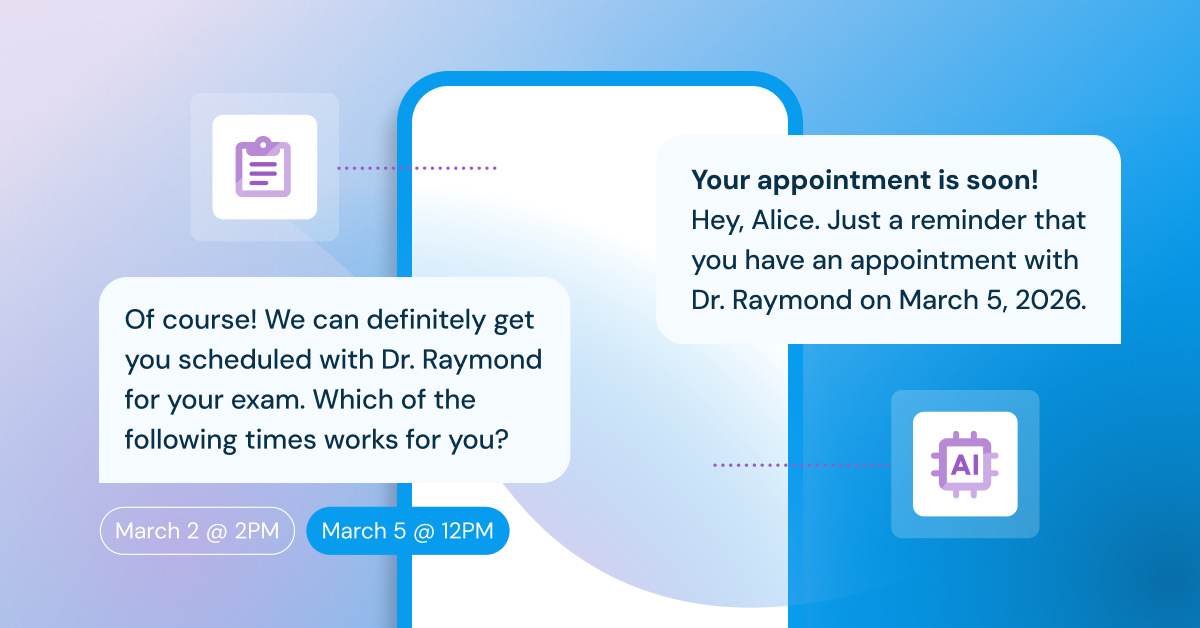
Appointment scheduling and reminders
Conversational AI can be used for scheduling patient appointments, sending confirmations and reminders, and easy rescheduling. This can help reduce administrative burden and the risk of no-shows, driving better patient experiences.
Patient intake
Optimize patient intake with conversational AI by automating the collection of patient information and essential health data. This can make registration simple and fast, as well as reduce the risk of errors from manual entry.
Post-visit follow up
Conversational AI can improve post-visit follow-up and patient engagement with timely, personalized outreach. With AI, healthcare organizations can program smart reminders for medications, vital signs, and exercise to encourage adherence to care plans, as well as prompt simple symptom checks that trigger education or staff review. Whenever collecting health information, it can be important to program certain words or phrases, such as “chest pain” or “trouble breathing,” to trigger escalation to a care team.
Basic admin and billing questions
Let conversational AI take on routine inquiries—from business hours and provider availability to more personalized requests like billing details and payment breakdowns. By triaging these questions with AI, healthcare organizations can reduce stress and frustration for both patients and admin, and streamline financial processes.
Schedule optimization
Use AI to manage complex scheduling and instantly fill blind spots or last‑minute openings. Patients get care faster, and healthcare organizations stop leaving revenue on the table.
What are the benefits of conversational AI in healthcare?
Conversational AI can unlock a wide range of advantages for the healthcare industry, from shrinking administrative workloads to boosting patient engagement and even improving health outcomes. By creating smoother, more accessible interactions between patients and providers, AI-powered tools can help healthcare organizations deliver better care with fewer bottlenecks.
Improve patient experience
Conversational AI can improve patient experiences by making care easier to access and simpler to navigate. With built-in translation services, 24/7 availability, and instant responses, these tools can remove common friction points like long hold times or language barriers. This enables patients to get clear, consistent answers whenever they call in.
Improve patient outcomes
With automated timely and consistent outreach to patients, both pre- and post-visit, conversational AI can help ensure patients stick to their assigned care plans. This can also boost patient engagement, ultimately driving better outcomes and healthier populations.
Reduce operational costs
Conversational AI can help healthcare organizations cut operational costs by automating many of the repetitive, routine tasks that normally require staff attention. Things like appointment reminders, basic intake questions, follow‑up messages, or simple status updates can all be handled automatically, freeing up care teams to focus on higher‑value work.
Improve efficiency
Conversational AI can streamline the way patients move through the healthcare system by handling the upfront information‑gathering process and quickly identifying what a caller needs. By routing patients to the right team on the first try—and reducing the back‑and‑forth that typically slows things down—these tools help create smoother, more coordinated workflows.
Real-world examples
Research studies are just starting to catch up and confirm the value of conversational AI in healthcare organizations. For example, Dehe et al. (2025) found that using conversational AI agents during outpatient visits increased overall patient experience scores by an average of 7.51%.
In the meanwhile, real-world successes provide evidence of impact.
“Voice will always have a place, but SMS and AI together are transformative. They reduce response times, prioritize urgent messages, and help clinics operate like modern tech companies.”
Anmol Oberoi, Co-founder and CEO of Emitrr
What are the key considerations when selecting a conversational AI platform for healthcare?
As healthcare organizations explore conversational AI, it’s important to think beyond the technology itself. Successful implementations come from balancing innovation with impact—protecting patient trust, maintaining clinical integrity, and ensuring compliance every step of the way.
Build responsibly
Healthcare is one of the most sensitive and highly regulated industries, and conversational AI flow must be designed with that in mind. Make sure to account for:
- Data privacy and security: to safeguard personal and protected health information
- Accuracy and reliability: so patients receive consistent and accurate guidance
- Ethical use: to ensure fair, unbiased interactions
- Transparency: so that patients understand when they are interacting with an AI agent instead of a human
Follow HIPAA regulations
It is imperative to choose a conversational AI vendor with knowledge and expertise on healthcare communications, who can provide you with the options that best fit your HIPAA compliance strategy. For example, you may be required to sign a Business Associate Agreement (BAA) with your AI provider to ensure that PHI remains protected when it’s handled by your provider. It is always best practice to work with your legal counsel to determine what will best fit your needs.
Define appropriate use cases
Conversational AI can do a lot of heavy lifting, but it isn’t meant to replace the clinical judgment or empathy of real care teams. The key is to be thoughtful about where it fits. Look for moments where AI can genuinely help—like simplifying administrative tasks, answering common questions, or guiding patients to the right next step—and make sure the more complex or emotionally sensitive interactions stay with human experts.
Monitor and optimize continuously
AI isn’t a ‘set‑it‑and‑forget‑it’ solution. Regularly reviewing analytics, patient feedback, and system performance helps organizations tune their conversational AI for accuracy, efficiency, and a better patient experience. Continuous improvement ensures the solution evolves with patient needs and organizational goals.
Conclusion
The potential of conversational AI in healthcare is enormous—but reaching it requires thoughtful, strategic implementation. When organizations deploy AI with clear goals, the right safeguards, and purposeful integration, they don’t just automate tasks—they elevate the entire patient and staff experience.
Reach out to Bandwidth if you’re looking for an experienced communications partner to help determine what deployments may best fit your organization and integrate conversational AI into your existing systems.
[1] Microsoft Azure, The State of AI Infrastructure 2024