Key takeaways:
Look beyond the CCaaS. Your software manages queues and agents. It cannot directly manage the network delivering calls to it. During a CAT event, the failure is almost always at the carrier layer.
Active/Active beats passive every time. Passive DR waits for something to break. Active/Active keeps multiple carrier paths live simultaneously, so calls redistribute automatically when one path goes down.
You don’t have to rip and replace. Bring Your Own Carrier (BYOC) separates your carrier from your CCaaS allowing de-risked migration through parallel SIP trunks, phased porting, and portal-controlled rollbacks.
Overnight, a hurricane makes landfall. By morning, thousands of policyholders are calling simultaneously, reporting damage, asking questions, filing claims. In minutes, your call volumes surge 400-500%. Regional infrastructure and local carrier networks, meanwhile, begin to choke and fail.
Policyholders don’t know (and shouldn’t have to care) about the emergency you’re experiencing from a logistics perspective, but they do expect to be able to reach you.
This is the reality of the CAT (catastrophe) season. For many insurance contact centers, the standard playbook is to prepare at the application level: tweak the Contact Center as a Service (CCaaS) platform, adjust IVR queues, or add temporary agent licenses.
CCaaS cannot route a call that never reaches it.
To build resilience for catastrophe season, insurance leaders must look deeper into the technology stack: down to the underlying carrier layer where voice traffic hits first.
Why carrier-layer failures, not application failures, bring down insurance contact centers during CAT events
When catastrophe hits, the insurance contact centers using calling plans bundled with their CCaaS feel it first. Their voice traffic is tied to a single, rigid path. During severe regional outages or massive traffic spikes, three major issues occur at the carrier layer:
- Network congestion: Local switches get flooded. Claims lines appear busy and the calls never even reach your IVR.
- Single points of failure: If the native carrier tied to your CCaaS platform experiences an outage, your entire voice operation goes dark, regardless of how many cloud agents you have standing by.
- Zero routing visibility: When calls fail, your IT team has no direct visibility into where the bottleneck is occurring and no ability to reroute traffic on the fly.
84% of organizations reported an increase in network outages over the previous two years, with more than a quarter seeing increases of 25–50%.1 For insurance contact centers, the stakes are measurably higher.
Active/Active vs passive disaster recovery
Overcoming that flawed structure requires moving from passive disaster recovery (waiting for something to break and swapping to a backup) to an Active/Active carrier architecture.
Instead of routing all inbound traffic through a single-threaded carrier setup, insurance contact centers should build in two critical capabilities:
- Advanced call routing: Get programmatic control of inbound voice traffic. Assign priority tiers and dynamic weighting across endpoints to streamline load balancing and set up instant failovers. This allows you to create additional resilience during outages and help calls reach active agents without carrier delays.
- Multi-carrier redundancy: Expands on that capability. Rather than relying on a primary network with a backup, multiple network paths can remain active at the same time. If one carrier path gets congested, calls flow across remaining active routes without dropping or delivering busy signals.
Active/Active: A carrier architecture where multiple network paths handle live call traffic simultaneously, eliminating single points of failure.
For an insurance carrier, this means policyholder claims reach your contact center queues, despite regional outages or networks in the area being severely degraded.
Can your toll-free infrastructure scale during surges in claims?
Assessing your toll-free architecture against the CAT season surge means asking a series of hard questions about the infrastructure:
- Carrier-level visibility: If policyholders receive busy signals during a storm, can your team see whether the congestion is happening at the local exchange, the carrier network, or inside your CCaaS platform?
Without direct carrier visibility, your IT team is troubleshooting in the dark, unable to distinguish a software queue problem from a network-level failure, which means slower resolution and more policyholders unable to get through. - Failover speed: How many minutes (or hours) does it take to reroute a primary claim line if a major regional network drops?
Every minute of manual rerouting during a CAT event is a minute of busy signals for policyholders filing claims. With carrier-layer control, your rerouting can happen significantly faster automatically, without manual intervention. - Carrier independence: If you decide to change or upgrade your CCaaS platform, are you forced to port all of your toll-free numbers and rebuild your call routing logic from scratch?
If you use CCaaS-bundled calling plans, your platform upgrade is a full-scale infrastructure migration. BYOC separates the two, so you can switch CCaaS ( or AI platforms) without touching your numbers or routing logic. - Surge capacity: Can your toll-free infrastructure handle a 500% spike in concurrent call volume without requiring advance manual provisioning from your provider?
Without elastic surge capacity, you’ll be forced to manually provision capacity. Policyholders face busy signals while your team scrambles to request additional capacity. - Direct escalation: When a voice outage occurs at 2 AM, do you have direct access to network engineers, or are you sitting in a general customer support ticket queue?
With some bundled calling plans, your team may find itself waiting on a CCaaS representative to escalate to their underlying carrier rather than troubleshooting directly with carrier network engineers.
If you want some answers, refer to the Insurance contact center carrier audit. It will steer you through several categories (like network reliability and platform resilience) to better understand what happens to your infrastructure during a catastrophic outage.
How much control do you have over your communications infrastructure?
If the checklist made you realize you need more carrier control, the direct path to get there is to Bring Your Own Carrier.
A lot of businesses choose a CCaaS platform and accept its native calling plan as a basic feature. But that leaves the carrier as an afterthought. BYOC flips that model on its head. or Bring Your Own Carrier (BYOC) separates the carrier layer from the CCaaS platform, giving insurance contact centers direct control over their toll-free numbers, SIP trunks, and routing logic, independent of the CCaaS platform.
If considering BYOC and still unsure about whether it’s a good idea, consider asking these questions:
- Can you switch contact center providers without changing your carrier?
- Can you retain your phone numbers and routing logic?
- Can you introduce AI or automation without rearchitecting voice?
- Can you migrate gradually instead of all at once?
If your current bundled plans make you answer “no” to any of the above, the more likely it is you’ll get value out of a BYOC arrangement. See how Genesys BYOC works
Addressing the elephant in the room: Migration friction
For telecom teams, the biggest hesitation around changing carriers is migration risk. The thought of porting thousands of critical toll-free claim numbers, re-testing integrations, and risking service disruption right before storm season is daunting.
You do not have to “rip and replace” your infrastructure to gain resilience.
Depending on your stack approach, carriers like Bandwidth help you de-risk your migration across two models:
1. Carrier migration (Keeping your existing contact center (CC) platform)
- Clean porting: Numbers are pre-validated and ported directly into a single Voice Configuration Package (VCP) mapped to your existing platform endpoints. It gives you direct carrier-layer control without re-architecturing or disrupting agents.
2. Contact Center platform migration
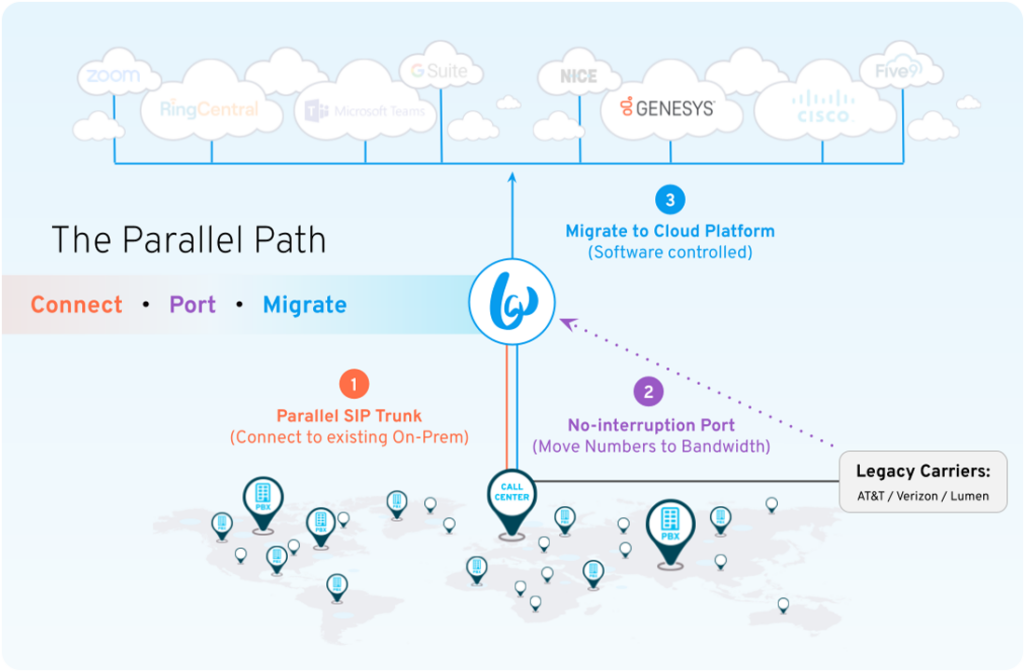
If you are moving to a different contact center platform, Bandwidth’s parallel migration architecture lets infrastructure teams maintain full visibility and control across both environments simultaneously. This allows:
- Parallel SIP trunks: Test new carrier routing side-by-side with your existing setup without disturbing production traffic.
- Phased number porting: Move non-critical number blocks or specific regional toll-free lines first to validate performance before porting core claims lines.
- Decoupled architecture: By separating your carrier from your CCaaS provider, you can switch or upgrade contact center software in the future without changing your underlying phone numbers or carrier routing logic. Bandwidth enables parallel path migration by installing parallel SIPs, decoupling porting from the platform migration, and offering instant rollbacks.
Bridging the gap between IT and contact center leadership
Building a resilient insurance contact center requires Infrastructure Leaders (who manage risk and network uptime) and Contact Center Leaders (who manage customer experience and operational metrics) to get on the same page.
| Leaders | Core challenge during CAT surges | How carrier-layer control helps |
|---|---|---|
| Contact Center / CX Leaders | High abandon rates, idle agents, failing service level agreements (SLAs), and frustrated policyholders. | Helps route every inbound call to the IVR queue, supporting agent utilization and CX metrics even during surges. |
| Telecom / Infrastructure Leaders | Carrier outages, lack of traffic visibility, rigid vendor contracts, and high-risk platform migrations. | Provides direct control over toll-free routing, real-time traffic monitoring, and allows you to de-risk migrations. |
Prepare before the surge hits
This article doesn’t argue that CAT season planning doesn’t matter. But the core part of your planning should focus on building from the infrastructure to be inherently resilient. Bring Your Own Carrier allows resilience to be built in and not be an afterthought.
Explore the BYOC solution with our Genesys BYOC walkthrough, especially if you need to get a better sense of how BYOC can give you more control during catastrophes.
References:
Opengear. “84% of Businesses Report Rising Network Outages Over Past Two Years.” September 3, 2025.
FAQs
BYOC is a deployment model that separates a contact center’s carrier layer, i.e.the PSTN connectivity and SIP trunking, from the contact center platform. Rather than using the calling plan bundled with the platform, the enterprise selects and controls its own carrier directly. This decoupling allows you to manage phone numbers, routing logic, and network redundancy independently of the contact center platform.
When regional networks fail during a catastrophe event, inbound calls fail before they reach the contact center’s IVR or queue. This is a carrier-layer problem. Additional agent licenses and IVR adjustments cannot solve this. Only carrier-level redundancy and programmatic traffic rerouting can prevent the busy signals policyholders experience during peak surge.
Active/Active is a network design in which multiple carrier paths handle live traffic simultaneously, rather than keeping a backup carrier idle until the primary network fails. In an Active/Active model, if one carrier path becomes jammed or drops, calls automatically flow across the remaining active routes without dropping or returning busy signals to the caller.
Passive disaster recovery waits for a primary carrier or contact center to fail before activating a backup. This causes switchover downtime during the switchover.
Cloud migrations with BYOC don’t require a hard cutover, at least not with Bandwidth. Our phased approach uses parallel SIP trunks, where new carrier routing runs alongside the existing setup, to check performance before porting numbers. Non-critical numbers and regional lines are typically migrated first. Core claims lines are ported only after the new carrier setup is validated. Bandwidth’s implementation model supports rollbacks throughout the process.