Imagine a major retail company gearing up for its biggest sales event of the year. Customers flood the contact center with questions, orders, and support requests—the phone lines are buzzing nonstop. Suddenly, an unexpected network outage takes down their inbound call system for over an hour. Calls go unanswered, customers get frustrated, and many abandon their purchases. Social media lights up with complaints while the company scrambles to triage outages and manage reputational damage.
Outages like this happen more often than anyone would like.1 The truth is, when your communication network fails, it’s not just a technical hiccup; it’s lost revenue, diminished customer trust, and operational headaches.
Because of this, network resilience underpins all aspects of customer communications, from voice and video calls to cloud application access. When the network falters, every call missed or delayed has ripples that extend throughout business operations. That’s why contact centers are increasingly prioritizing infrastructure built to withstand faults without downtime—because resilience at the network layer directly equals resilience in communication experience.
Comparing network architectures: Active/Active vs. Active/Passive
Understanding the architecture behind resilient toll-free starts with comparing the two main approaches:
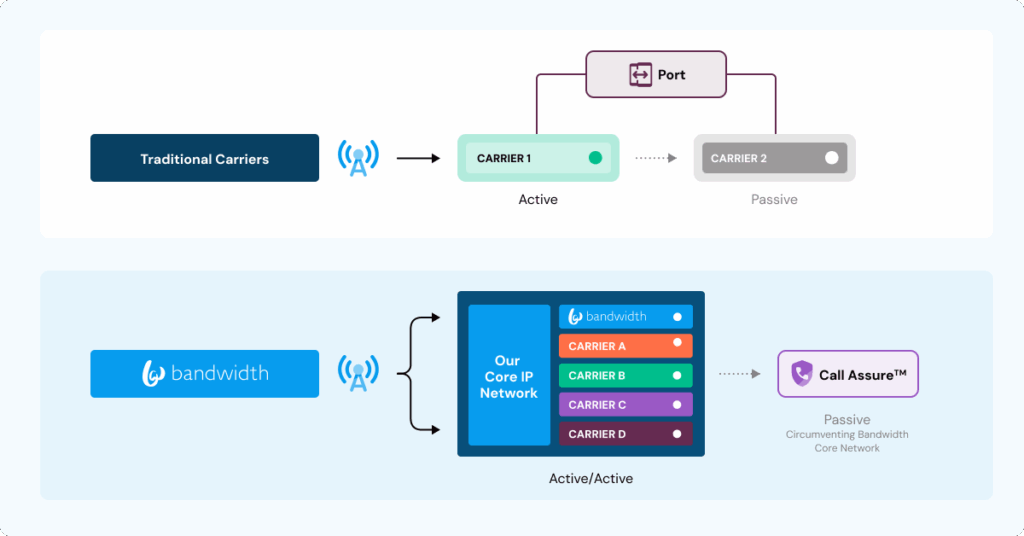
- Active/Passive architecture: In this setup, one network path is actively carrying traffic while one or more others remain on standby, ready to take over only when the active path fails. Although this design supports backup availability, it can introduce potential downtime during failover periods. For high-demand contact centers, even brief outages during this switch can be costly.
- Active/Active architecture: Here, multiple networks operate simultaneously and share traffic loads. This model provides higher fault tolerance because there isn’t a single point of failure–the networks actively support each other. If one path experiences an issue, traffic is seamlessly rerouted to another, ensuring continuous connectivity and minimizing the risk of disruption altogether.
It’s like having multiple highways to the same destination—if one is blocked, you simply take another.
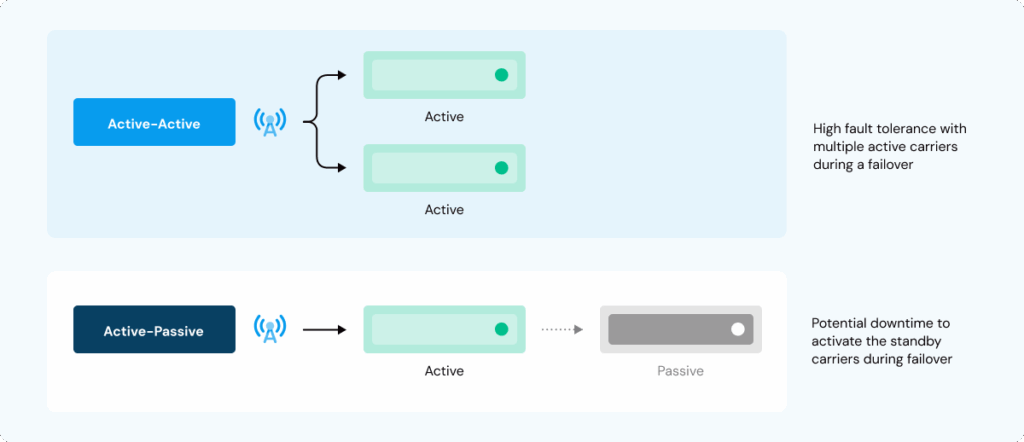
The trade-off between these architectures often lies in complexity and cost. Active/Active requires more sophisticated orchestration but rewards with a better user experience, particularly for contact centers where uptime is non-negotiable.
What’s a real-world example of the Active/Active architecture?
Let’s break down how Active/Active networks support your contact center resilience.
Bandwidth’s toll-free services are built on an Active/Active network architecture and bolstered by a disaster recovery solution. Here’s how this system works to both:
- minimize the downtime in your contact center during an outage
- optimize call routes for quality at all times
Picture a call traveling from left to right: when a toll-free number is dialed, the traffic begins at the originating network and queries the SMS/800 database to identify the number’s routing information. Bandwidth’s system then routes the call intelligently across five peered carriers:
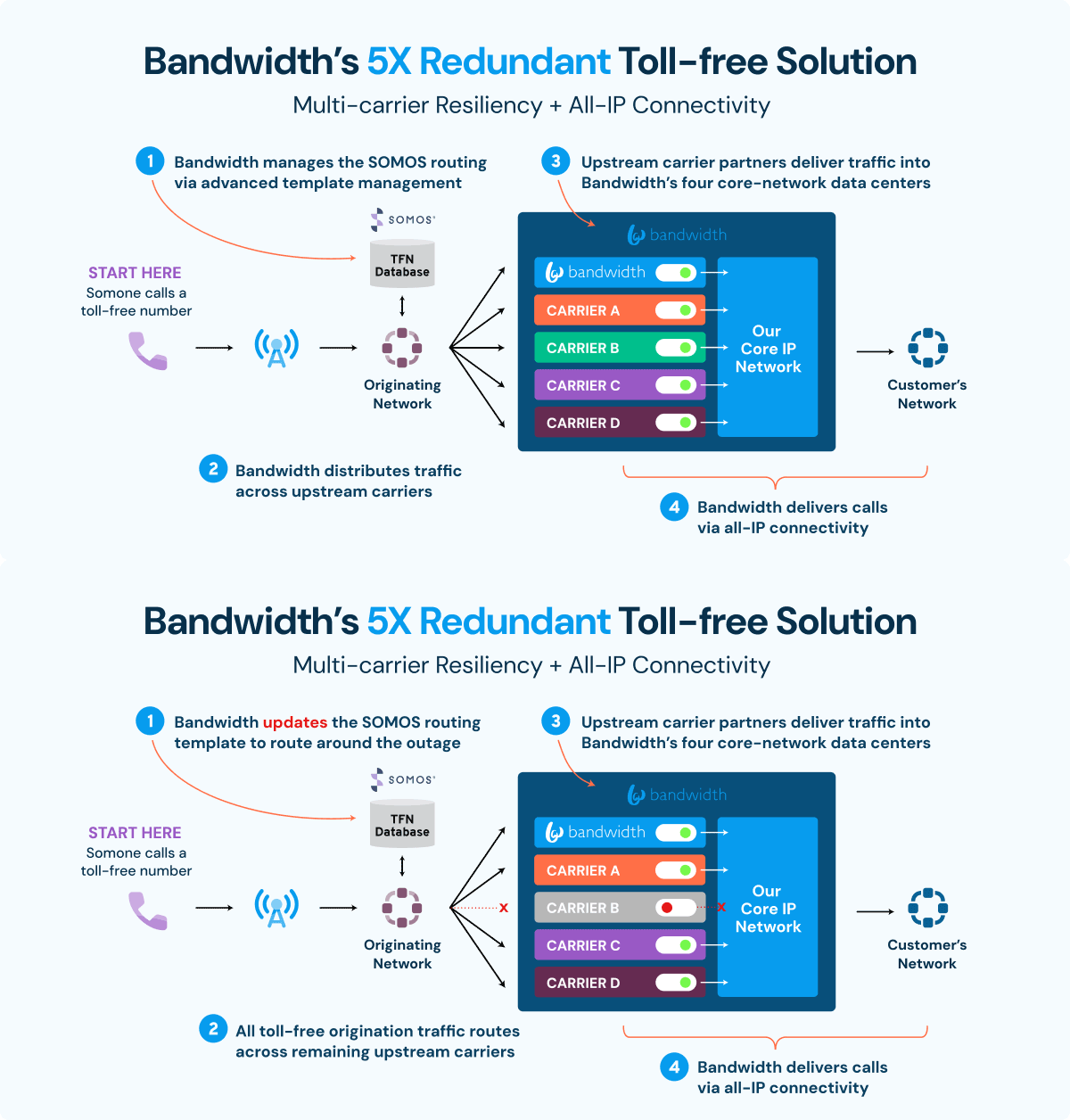
In addition to Bandwidth’s own toll-free network, we have direct peering agreements with four Tier-1 carriers in the US, creating a carrier n+1 aggregator redundancy—essentially, a safety net of interconnected networks. This means that if one active carrier experiences an issue, your traffic is automatically routed through another active carrier using AI-powered logic, without interruption. It eliminates the need for porting during a crisis.
This architecture carries important benefits:
- Direct peering: If a toll-free number originates from Carrier A, calls can be sent directly over Carrier A’s network, ensuring superior call quality and least-cost routing. Direct peering reduces routing across multiple networks, lowering latency and improving user experience.
- Feature Group D Network: Bandwidth’s proprietary toll-free network operates in 160+ LATAs and is exclusively available to our customers. This private network grants us control over traffic flow and prioritization, leading to consistently higher connection quality and an average 10% cost reduction.
- Geographically diverse core: Calls pass through our four core data centers strategically spread across the US, ensuring 99.999%* core uptime.
- Fraud mitigation: Around-the-clock monitoring across our and peered networks detects and neutralizes fraudulent activity such as toll fraud and toll-free pumping, enhancing security and minimizing risk.
This architecture is also backed up by a hands-free disaster recovery solution that unlocks additional resilience, Call AssureTM. It comes into action in the rare case where the entire Active/Active core is impacted by an extraordinary disaster, safely routing calls that traverse through the cloud or on-premise infrastructure.
How to crisis-proof your Contact Center in 2025
Contact center resilience checklist, scorecard, and strategies to protect your contact center against downtime in 2025
Active/Active via Advanced Call Routing (ACR)
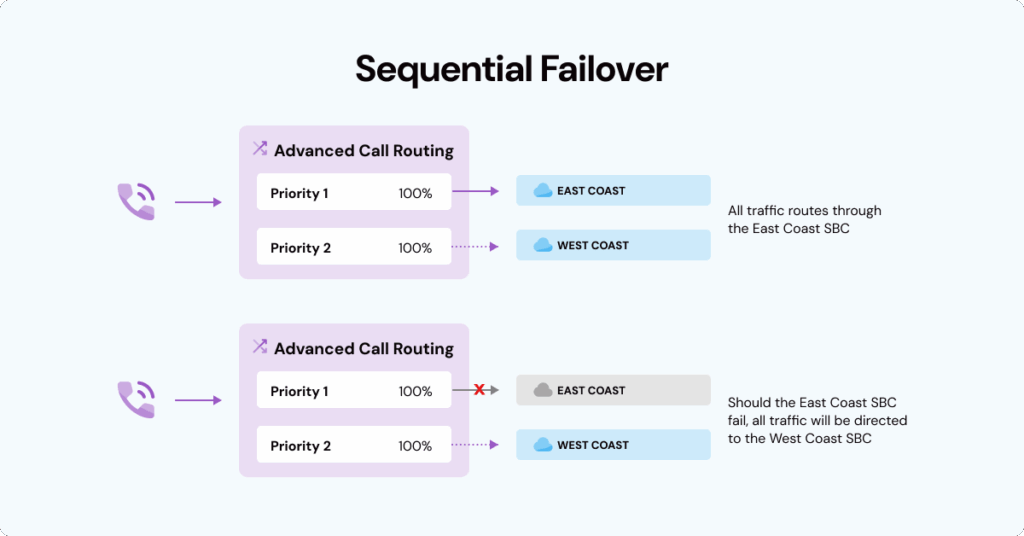
Beyond the physical network architecture, call routing—the rules that direct inbound calls within a contact center—is a critical layer in delivering resilience. Bandwidth’s Advanced Call Routing allows customers to assign priorities or different weighting values to endpoints.
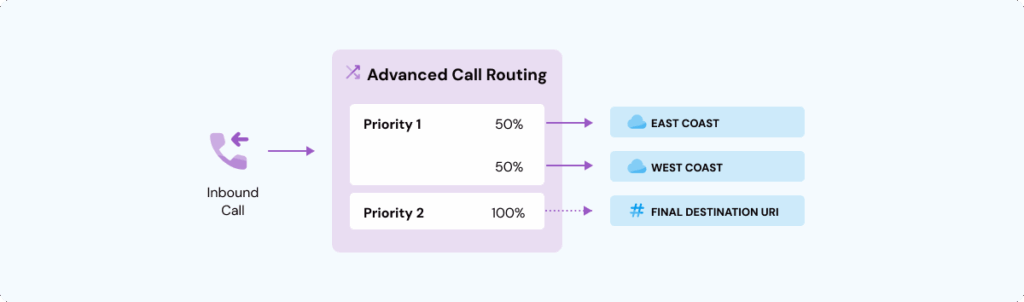
Advanced Call Routing empowers customers to set customized call distribution policies with granular control including:
1. Sequential failover across voice hosts: Automatically redirecting calls to backup hosts when the primary is unavailable.
2. Random distribution (round-robin): Load balancing calls evenly to multiple endpoints.
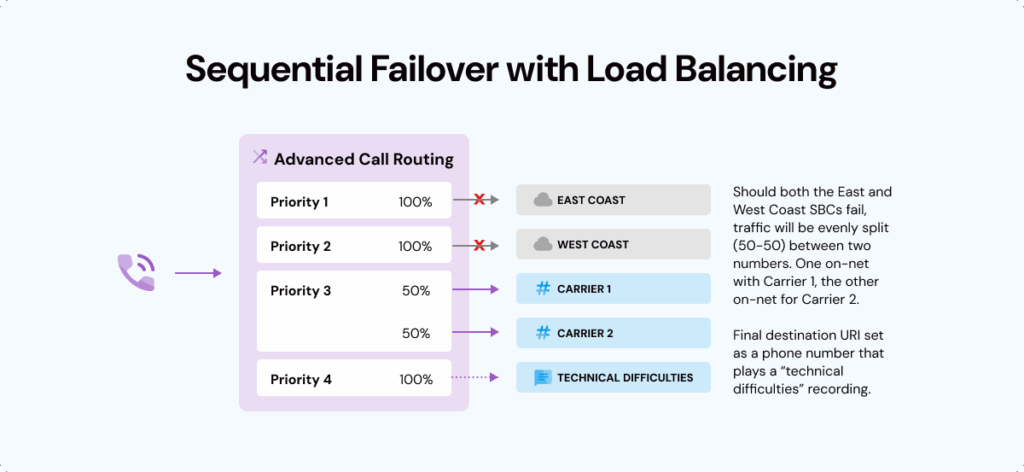
If you’re testing a new server, you can slowly increase load distribution to see if it can handle the traffic

3. Telephone number-level call forwarding: Routing calls based on specific phone numbers.
4. Final destination URI routing: Managing where calls terminate at the telephone number and location level.
Take a tour: See how you can set up Advanced Call Routing easily inside the Bandwidth app.
How Bandwidth powers this resilience
At the core of Bandwidth’s network resilience is telephony expertise and intelligent routing purpose-built to maximize uptime and call quality. All that’s necessary to benefit from Bandwidth’s architecture are:
- Numbers ported directly to Bandwidth.
- Connectivity over IP via private (e.g., MegaPort, Equinix) or encrypted public networks.
With these in place, customers benefit from:
- Proactive template management: Continuous 24/7 monitoring tracks toll-free traffic patterns, allowing Bandwidth to update SOMOS routing templates before outages impact your calls.
- Routing optimization: Templates and call flows are reviewed and refined every 14-30 days to ensure peak efficiency and reliability.
- Reactive template management: If an outage occurs, Bandwidth’s Network Operations Center (NOC) quickly identifies root causes and dynamically updates routing templates to bypass affected carriers or regions, restoring service typically before customers detect issues.
This layered management combined with physical multi-carrier redundancy delivers:
- Built-in resiliency and redundancy from day one
- 5x carrier redundancy bundled into a single contract, simplifying SLAs and vendor management
- Hybrid connectivity options and seamless migrations
- Enterprise-level SLA execution at competitive costs—with formal SLAs available upon contract.
Did we activate you to crisis-proof your contact center with Active/Active architecture? If yes, check out Bandwidth’s 5x carrier-redundant toll-free services and backup of all backups, Call Assure.
*In the US. 99.995% globally
[1] Ookla, Too Big to Fail? The Largest Outages in 2024 According to Downdetector
Ready to strengthen your network resilience with Active/Active solutions?
Talk to our experts to explore how our active/active, 5x carrier-redundant toll-free architecture can transform your customer communications—seamlessly, securely, and always available.